Vaping Products Duty (VPD) applies from 1 October 2026. From then, every vaping product made in or imported into the UK needs a vaping duty stamp before sale. However, the scheme starts with two different stamps, and they follow very different timelines. For brand owners, that difference shapes packaging, stock planning and even your route to market. So here's a clear guide to both stamp types, what each one means for your brand, and how to keep your stamping covered.
What a vape duty stamp does
Vaping Products Duty adds £2.20 of excise duty for every 10ml of vaping liquid. The duty stamp works alongside it as visible proof. It's a secure label with physical security features, and it helps retailers, enforcement teams and HMRC spot legitimate stock.
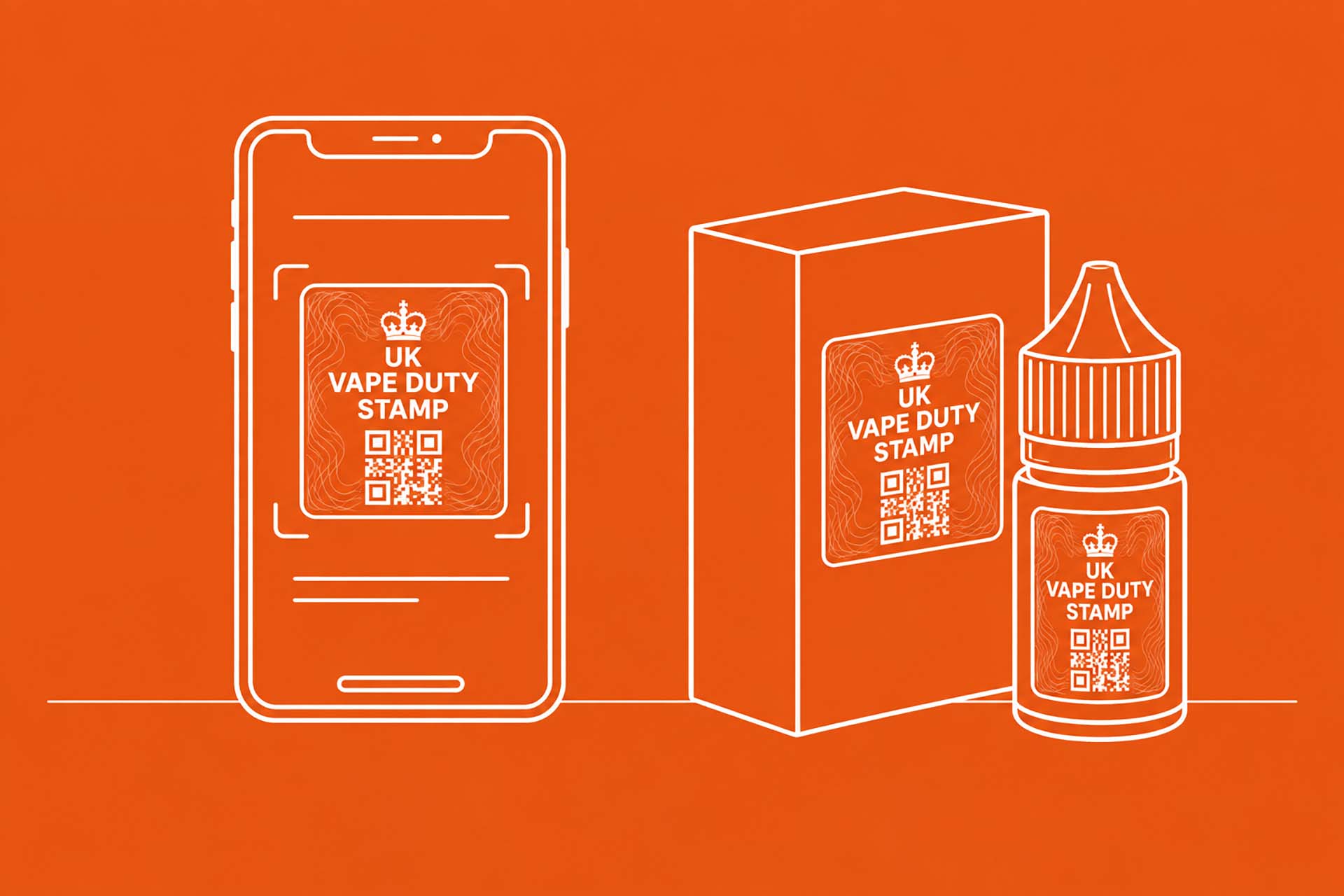
The stamp goes on the outermost retail packaging. That means the box, or the bottle itself if you sell it without a box. It also has to seal the pack, so nobody can open it without damaging the packaging or the stamp. Stamps can't be reused, either.
Across the trade, people often call this "vape stamp duty". Officially, the rules sit under HMRC's Vaping Duty Stamps Scheme (VDS). They cover every e-liquid, whether it contains nicotine or not.
Transitional vs digital duty stamps: the core difference
Both stamps do the same basic job. The real difference shows up after the stamp goes on.
The transitional duty stamp
The transitional stamp carries physical security features only. It has no scannable code, so nobody scans it at any point in the supply chain. HMRC introduced it as a bridge, giving production lines time to adapt before the digital system takes over.
The digital duty stamp
The digital stamp carries the same physical features, plus a unique scannable code. Whoever applies it must activate it at the moment of affixing. That activation links each stamp to a set of product and operator details. After that, the stamp gets scanned again at set points, including permitted movements under duty suspension and release for consumption.
In practice, the digital stamp turns every retail unit into a traceable record. As a result, HMRC can follow a product from the production line to the shelf.
| Feature | Transitional stamp | Digital stamp |
|---|---|---|
| Physical security features | Yes | Yes |
| Scannable unique code | No | Yes |
| Activation when affixed | No | Yes, by the affixing operator |
| Scanned through the supply chain | No | Yes, at affixing, permitted duty-suspended movements and release |
| Linked product data | No | Yes, from the SKU record |
| Aggregation codes for cartons and pallets | No | Yes |
| Long-term role | Being phased out | The permanent standard |
Transitional stamp deadlines and the dates to plan around
The transitional stamp has a short, fixed life. Approved businesses can buy transitional stamps until 30 November 2026 and affix them until 31 December 2026. Digital stamps have been available since 1 September 2026. Then, from 1 January 2027, digital becomes the only stamp anyone can affix.
Meanwhile, a separate clock runs for older stock. Retailers and wholesalers can keep selling eligible unstamped stock they already hold until 31 March 2027. After that, every vaping product outside duty suspension needs a stamp.
You may still see older dates online. HMRC's first timetable closed transitional stamp sales on 31 August 2026. It then extended the window following industry feedback, so the dates above are the current ones.
What brand owners need to know
You probably won't buy stamps yourself
Only HMRC-approved purchasing operators can buy stamps. That means UK manufacturers, warehousekeepers and UK representatives, ordering through the appointed supplier's secure platform. HMRC also caps each operator's purchases over a rolling three-month period. So unless you hold those approvals yourself, your stamps come through a partner. For that reason, your partner's approvals, limits and stamp controls matter as much as your own planning.
Your product data becomes part of the stamp
Digital stamps link to product records in the supplier's system. For each SKU, HMRC's guidance asks for details such as the GTIN barcode, brand, flavour and product type. It also asks for volume to the nearest 0.1ml, nicotine strength and a JPEG product image. Nicotine products also need their ECID or GBID notification number.
Most brand owners hold this information already. However, it often sits across spec sheets, artwork files and notification records. Pulling it into one clean dataset now avoids delays at the stamping stage.
Transitional stamps suit short runs, not long plans
A transitional stamp only helps if it goes on before 31 December 2026. So any stock that won't reach finishing by then should plan for digital from the start. Otherwise, you risk ordering stamps for a pipeline that outlasts the affixing window.
Digital stamping puts new work on whoever affixes
The digital stamp brings activation, data capture and scanning at several stages. Packed units also need aggregation codes for cartons, master cases and pallets. Operators report these through an API built to the GS1 EPCIS standard. None of this needs special hardware, since any iOS or Android device can scan a code through an app. Still, it needs a reliable process on every single run.
This matters most if an overseas factory stamps your goods. First, a UK representative must buy the stamps on the factory's behalf. Then the factory has to activate and scan every digital stamp correctly, outside the UK.
Your packaging still needs a home for the stamp
The stamp needs a clear spot on the outermost pack where it seals the opening. The supplier's testing shows a digital code still scans on curves down to a 10mm radius. So most boxes, bottles and pods can carry one. Even so, check your artwork before your next print run. For timing, our duty stamp timeline shows how far ahead stamp orders need to start.
How Xyfil covers your stamping, whichever route you take
Every brand reaches the UK market differently, so the stamp switch lands differently too. Below, we focus on what the move to digital stamps means on each route. For a full side-by-side of the services themselves, see our comparison of Xyfil's stamping and fulfilment routes.
If we already manufacture for you
Stamping already sits inside our production process. So the move from transitional to digital stamps happens on our line, and nothing changes on your side.
If you import part-finished stock
Your goods arrive without the retail box and stay unstamped until we finish them in the UK. As a result, you never hold transitional stamps that might outlast the affixing window. We simply apply the stamp each date requires, and from January that means digital. Our guide to importing part-finished stock covers the wider benefits of this route.
If you import retail-ready stock
We stamp your finished packs on arrival and release them to the market. From 1 January 2027, that stamp will be digital, and we handle activation and scanning as we affix it.
If your own overseas factory stamps
This route changes the most. Whoever affixes a digital stamp must activate and scan it, so your factory takes on that work. We plan the process with you before any stamps ship, alongside the bank guarantee and reconciliation the route requires.
If you're based overseas
You'll need a UK representative to take part in the scheme at all. Our import representation service covers registration, stamp requisition, duty accounting and HMRC liaison.
Once your stock is stamped
Our fulfilment and storage service holds stock in duty suspension until orders call for it. That way, your duty point follows your sales rather than your stock arrivals.
Vape duty stamp FAQs
When do transitional vape duty stamps stop?
The buying window closes on 30 November 2026. After that, the last day to apply one is 31 December 2026. New stock then takes digital stamps only.
Can stock with a transitional stamp still be sold in 2027?
HMRC's cut-offs apply to buying and affixing transitional stamps. Its guidance doesn't set a separate sell-by date for stock that already carries one. So if you plan to hold transitionally stamped stock for a long time, check your position with HMRC first.
Do overseas manufacturers need a UK representative?
Yes, if they want to affix stamps as part of their own manufacturing process. The UK representative applies for approval and buys the stamps on their behalf.
Does nicotine-free e-liquid need a duty stamp?
Yes. Vaping Products Duty covers all vaping liquid, with or without nicotine. So nicotine-free products need a stamp too.
Do I need special scanners for digital duty stamps?
No. HMRC's guidance sets no scanner model requirements, and an iOS or Android device can scan codes through an app. However, third-party scanners need their own integration with the supplier's API.
Preparing your brand for digital duty stamps
Transitional stamps will fade out within months, while digital stamps become the permanent standard. For most brand owners, the sensible move is to plan around digital now. Start with your product data, check your packaging, then pick the route that fits your supply chain.
Want a second pair of eyes? Send us your product list and current route to market. We'll show you how each stamp type affects your plans, and which Xyfil service keeps you covered. Book a call with the team.