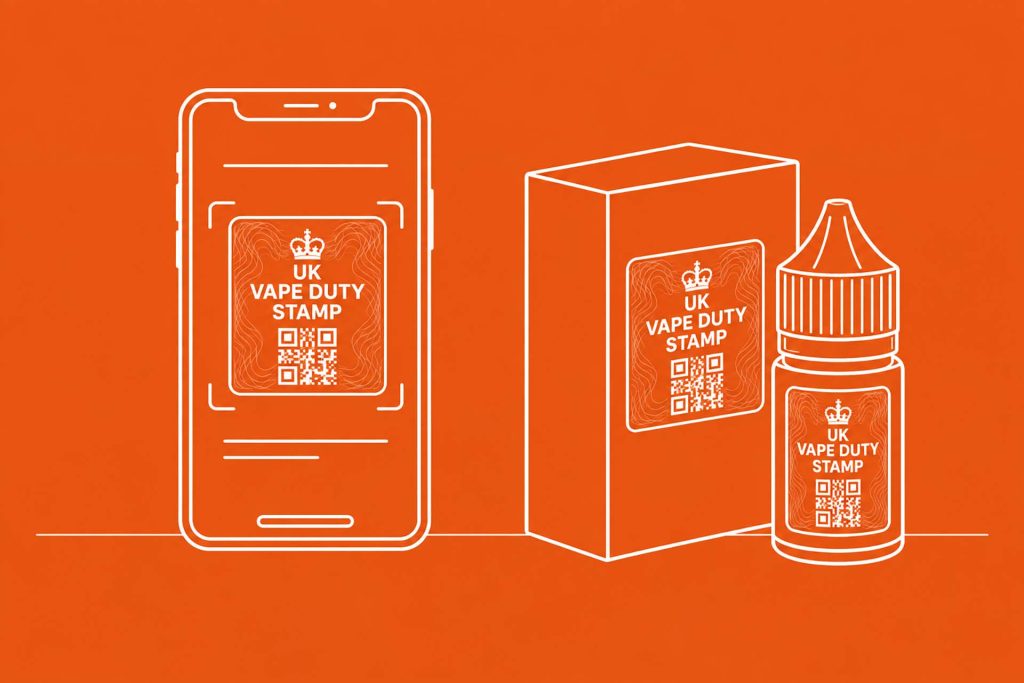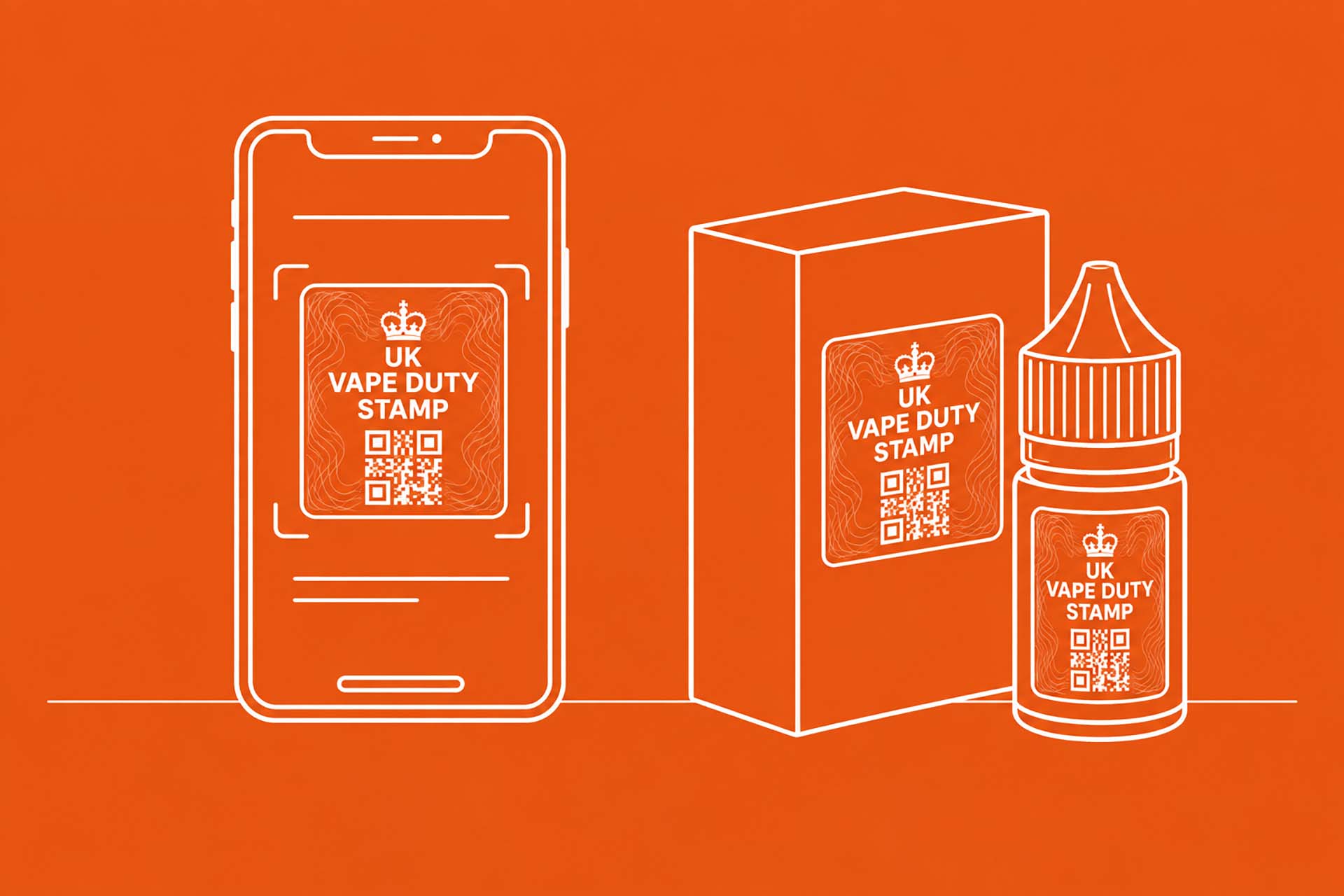

Lost or damaged vaping duty stamps rarely make headlines. Yet since Vaping Products Duty went live on October 1st, 2026, every single stamp needs an ending someone can explain. It either goes on a pack, goes back to the supplier or goes through HMRC's destruction process. For brand owners, that raises a fair question. If a stamp goes missing, tears on the line or never reaches a pack, who carries the risk?
The short answer is that responsibility follows the stamps. HMRC published new manual guidance on stamp destruction on October 12th, 2026, and it makes the rules much clearer. This guide walks through what happens to lost, damaged and wasted stamps, and how the right route to market keeps that risk away from your business.
Key takeaways
- Whoever buys and holds your stamps carries the responsibility for them. For overseas manufacturers, that means the UK representative.
- HMRC treats any stamp an operator can't account for as lost, and penalties may apply. However, HMRC won't charge one where the holder took all reasonable steps to prevent the loss.
- Damaged stamps follow a set process: tell the supplier, start destruction within one calendar month, keep photos for 12 months and keep records for six years.
- Most wasted stamps come from testing, leftover transitional stamps, stamps left unused for 12 months or exports. Good planning keeps all four low.
- An approved partner that holds and applies your stamps in the UK keeps the day-to-day risk inside its own process.
Why every vaping duty stamp counts
Vaping duty stamps work more like banknotes than labels. Only HMRC-approved purchasing operators can buy them. That means UK manufacturers, warehousekeepers and UK representatives. HMRC's briefing also confirms that nobody can reuse a stamp. In general, the business that buys a stamp can't pass it on to anyone else, either.
As a result, every stamp needs a clear outcome. Either it goes on a product, it returns to the supplier, or the operator destroys it under HMRC's rules. HMRC asks operators to reconcile stamps ordered, received, used, returned and destroyed as a matter of routine. When a stamp falls outside all of those, HMRC treats it as lost. Its manual adds that the trader could then face penalties.
That might sound strict. In practice, though, it simply rewards good housekeeping. A business that tracks its stamps carefully has very little to worry about.
Lost or stolen vaping duty stamps
HMRC expects every operator to run an incident process for loss, theft, damage and discrepancies. Its record-keeping guidance also asks for records of lost, stolen or damaged stamps, along with the outcome of each incident.
For brand owners, the key question is who holds the stamps day to day. If you hold your own approvals and buy your own stamps, the responsibility sits with you. However, most brand owners don't buy HMRC duty stamps directly. Instead, an approved manufacturer, warehousekeeper or UK representative buys and holds them on their behalf.
Overseas brands have a specific arrangement. An overseas manufacturer that wants to stamp products itself needs a UK representative to buy the stamps for it. In its consultation response, the government confirmed that the UK representative carries the liability for stamps that go missing or stay unaccounted for. That's why stamps that travel abroad need such careful handling.
The penalty for each lost stamp is five times the duty on 10ml of liquid, which comes to £11 at today's rate. There's an important safeguard, too. HMRC won't charge a penalty for a lost stamp if the holder didn't cause the loss and took all reasonable steps to prevent it. In other words, strong controls protect whoever holds the stamps.
In our experience, the simplest protection is fewer handovers. Each time a reel changes hands or crosses a border, the chain of custody grows longer. Keeping stamps at one secure UK site, with one team responsible for them, keeps that chain short and easy to check.
Damaged vaping duty stamps: what HMRC expects
HMRC's guidance splits damage into two situations. The steps differ slightly, which makes it worth knowing which one applies.
Stamps that arrive damaged
Sometimes a delivery from the stamp supplier includes damaged stamps. In that case, you can choose whether to return them or destroy them. Either way, you need to tell the supplier as soon as you reasonably can, and include photos of the damage.
Stamps damaged on site
Stamps can also suffer damage after delivery, for example in storage or on the production line. Here, you must destroy them. You also need to:
- Tell the supplier that the stamp has suffered damage and that you plan to destroy it.
- Take photos of the damage where possible, and keep them for 12 months.
- Keep records of the destroyed stamp for six years.
In both situations, destruction must begin within one calendar month of finding the damage. You'll also need to notify HMRC and keep destruction records, which we cover below. Good packaging design helps here too, because a stamp with a clear, flat home on the pack is far less likely to tear. Our guide to designing packaging for stamp integrity explains how.
When a stamp counts as destroyed
HMRC sets a clear test. A stamp only counts as destroyed when nobody could still fix it to retail packaging, or when both its barcode and its human-readable code have become unreadable. If anyone can still read either code, or the stamp could still go on a pack, it doesn't count as destroyed. In other words, a half-torn stamp with a legible code still needs proper destruction.
Wasted stamps: four common causes
Not every unused stamp involves an accident. Some waste comes with normal production. The good news is that planning keeps all four of these causes small.
1. Line testing
New equipment and new packaging need test runs. For that reason, HMRC allows a small testing allowance without a separate notice. The limit is 5,000 stamps or 1% of the operator's purchase limit, whichever is lower. The operator must still destroy any stamps that don't apply properly, and keep records. Above that allowance, the normal notification rules apply.
2. Leftover transitional stamps
Approved operators can buy transitional stamps until November 30th, 2026 and affix them until December 31st, 2026. From January 1st, 2027, only digital stamps can go on. Any transitional stamps still on the shelf after that will need destroying under HMRC's process. Careful ordering now keeps that number low. Our guide to digital vs transitional vape duty stamps explains the switch in full.
3. Stamps left unused for 12 months
HMRC treats a stamp as lost if, 12 months after issue, nobody has affixed and activated it, returned it to the supplier or destroyed it. Operators also need to activate digital stamps within 12 months of receiving them. Ordering against a realistic forecast avoids reels that sit in storage for too long.
4. Stamped stock that goes for export
If stamped product leaves the UK, HMRC requires the operator to destroy the stamp first. The same applies to other uses such as ship and aircraft stores. Every stamped unit you export therefore uses up a stamp you never needed. Keeping stock unstamped until you know its destination avoids that waste altogether.
How to destroy vaping duty stamps properly
Destroying stamps is a planned step, never a quick tidy-up. Before you deliberately destroy unused stamps, you must tell HMRC:
- the method of destruction
- the time and date
- the location
You can notify HMRC by email at vapingenquiries@hmrc.gov.uk or in writing to its Excise Processing Team. HMRC's manual makes clear that operators shouldn't deliberately destroy stamps without this prior agreement, apart from the testing allowance.
Afterwards, your destruction records need to show:
- the stamp details (each digital stamp, or the boxes for transitional stamps)
- the exact quantity
- the reason for destruction
- the date and time
- the method
- any certificate from a third-party destruction service
You'll need to keep these records for six years. During checks, HMRC officers look for records that reconcile with your stamp inventory. They also look for a complete trail from purchase through to destruction.
Who carries the risk on each route to market
Responsibility follows the stamps. Here's how that plays out across the most common routes.
You stamp your own products
If you hold your own approvals, you hold the stamps and the full responsibility for them. That includes secure storage, reconciliation, incident processes and destruction records.
Your manufacturer stamps for you
When an approved manufacturer buys, holds and applies your stamps, the day-to-day controls sit inside its process. Your role becomes simpler: supply accurate product data and a sensible forecast. It's still worth asking how your agreement treats spoilage. That way, everyone knows where they stand from the start.
Your own overseas factory stamps
On this route, stamps leave the UK and travel to your factory. The UK representative carries the liability, which is why this route needs a bank guarantee and strict reconciliation. Your factory also takes on activation and scanning for digital stamps. If you need a UK presence first, import representation covers registration, stamp requisition and HMRC liaison.
You import part-finished goods and finish in the UK
This route keeps stamps out of transit altogether. Your goods arrive without the retail box, under duty suspension. The stamps then go on in an approved UK facility shortly before release. As a result, stamps never cross a border, and stock you later export never needs a stamp destroying. Duty still falls due in full when goods leave duty suspension. The route simply moves that timing to the point of release.
Questions to ask your stamping partner
Whoever applies your stamps, a short conversation shows how well they manage them. These questions are a good place to start:
- Where do you store our stamps, and who can access them?
- How often do you reconcile stamps, and can we see the results?
- What happens if a stamp suffers damage on your line?
- How do you handle HMRC destruction notices and records?
- How do you size stamp orders to avoid leftovers and late activation?
- Who carries the liability if a stamp goes missing?
Clear, specific answers are a good sign. For more questions about the move from transitional duty stamps to digital, see our guide on what to ask your manufacturer before January 1st.
How Xyfil keeps stamp risk off your books
We've manufactured e-liquid in Preston since 2014. Our VPD approvals cover production, import, warehousing, duty stamp affixing and UK duty representation. As a result, buying, holding and applying your stamps all happen inside one approved business.
Your stamps stay in our secure UK custody. We order against your forecast, which keeps leftovers and late activations to a minimum. Every run then closes with a reconciliation pack, and each stamp ties back to its HMRC dataset and a GS1-aggregated batch record. If a stamp ever suffers damage on our line, our team follows HMRC's process from the supplier notice through to the destruction record.
For importers, our UK Stamping & Finishing route also lets you stamp on demand. Your part-finished goods wait under duty suspension until you're ready to release them, and only then do the stamps go on. You can compare every option in our stamping and fulfilment route comparison.
Vaping duty stamp FAQs
What happens if a vaping duty stamp is lost?
Can you reuse a damaged vaping duty stamp?
Do I need to tell HMRC before destroying duty stamps?
What happens to unused transitional stamps after December 31st?
Who is responsible for duty stamps if my manufacturer applies them?
Keep your stamps where the risk is lowest
Tell us how your stamps reach your packs today, from who orders them to where they go on. We'll show you where the risk sits now, and which route keeps it lowest for your range. Get in touch with the team
Further reading and sources (all checked October 23rd, 2026)
- VPDS231600: damaged stamps destruction
- VPDS231100: notification to HMRC
- VPDS231200: records to be kept
- VPDS231300: when a stamp is considered destroyed
- VPDS231400: stamps destroyed during testing
- VPDS231500: exports and stores
- How vaping duty stamps work (updated August 26th, 2026)
- Keeping records for VPD and the Vaping Duty Stamps Scheme
- Prepare for VPD and the Vaping Duty Stamps Scheme
- Vaping duty stamps: penalties and sanctions (CC/FS87)
- VPDS193200: lost duty stamps, penalty rate
- Finance Act 2026, Part 4 (section 126: loss and misuse of duty stamps)
- Response to consultation on additional compliance measures