• 01772 888 778
  • info@xyfil.com
  • Unit 1 & 2, Durton Lane Business Park, Preston, PR3 5LR

Category Archives: Vaping Products Duty

Which VPD Route Fits Your Business? Comparing Xyfil’s Stamping & Fulfilment Options

From October 1st, every unit of vaping liquid sold in the UK carries a duty stamp. That single rule reaches every brand owner in the market, no matter how your liquid gets made. Maybe Xyfil already manufactures your range. Maybe you import finished stock from an overseas factory. Maybe your production sits somewhere between the two. Either way, the question isn't whether you need a stamp on your product. It's which route gets you there without slowing your business down.

We built several service routes because brand owners don't all start from the same place. This article walks through each one. It looks closely at the stamping side, so you can work out which route fits your situation and book the readiness call that gets it moving.

Whichever way you make your liquid, the stamp still lands on you

Vaping Products Duty attaches to the product, not to whoever happens to manufacture it. So if you outsource production, import stock, or run your own overseas factory, the stamp requirement still follows your liquid to a UK shelf. Once you know a stamp has to go on, you need to know who puts it there, and how.

That's where the four routes below come in. Each one answers a different starting point. Together, they cover almost every brand owner working toward the 1st of October.

Already manufacturing with us? The stamp is already built in

If Xyfil makes your liquid, this part stays simple. Duty stamp affixing sits inside our standard production process, alongside batch tracking and the audit trail HMRC expects to see. You don't add a step, book a separate supplier, or plan a second movement of goods. The stamp goes on as your bottles come off the line, right alongside everything else we already do for you.

That's the advantage of one relationship covering the whole job. Nothing changes about how you work with us today. You simply end up with a stamped, compliant product, without lifting a finger.

Importing part-finished stock? UK Stamping & Finishing keeps you duty-suspended

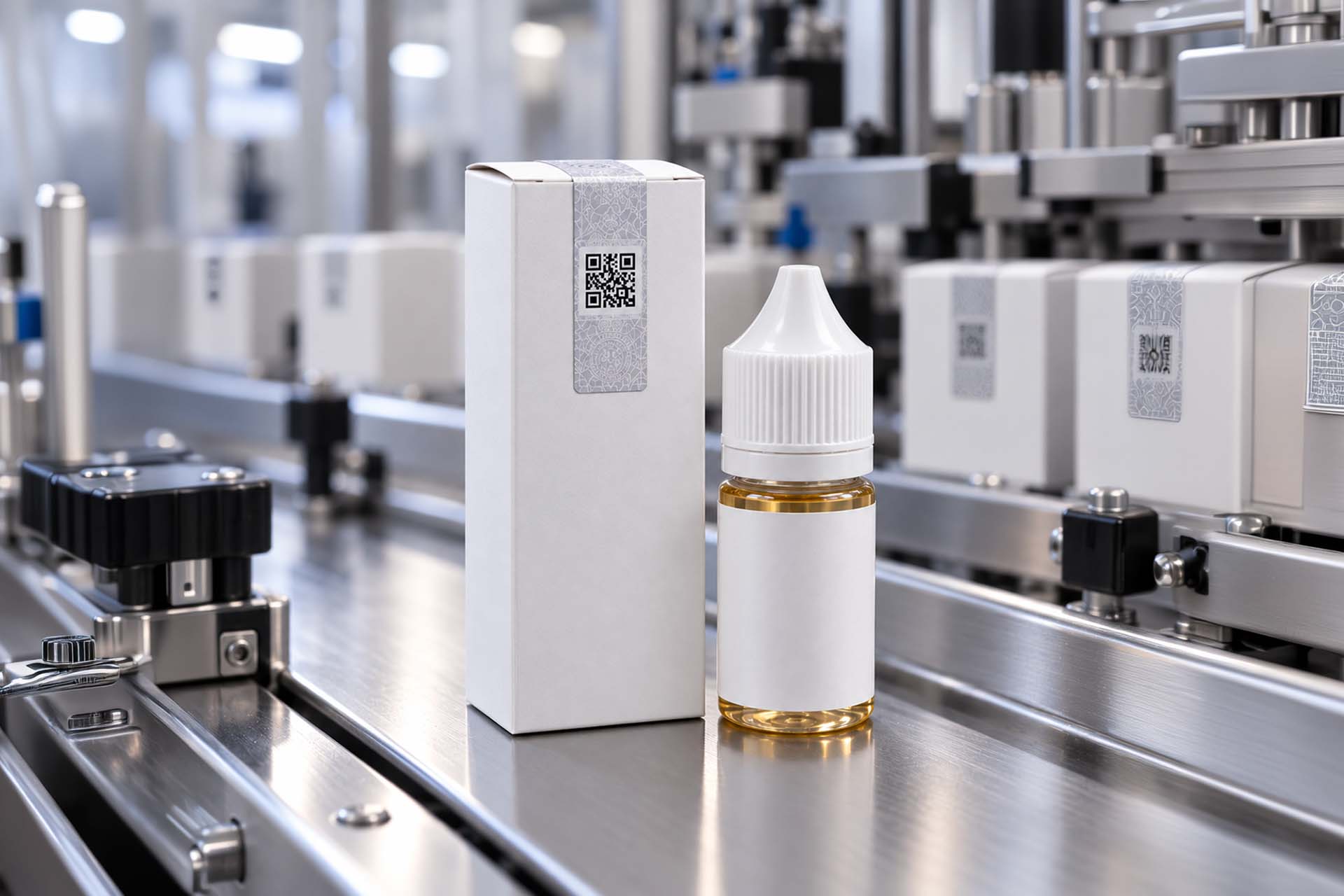
Plenty of brand owners import in bulk and finish closer to the point of sale. The new duty hasn't broken that model. If anything, it's made the model stronger. Under UK Stamping & Finishing, your part-finished goods arrive at our Preston site under duty suspension. From there, we complete carton assembly and insert your leaflets. We apply the stamp, seal the packs, and case the finished product, all before anything moves on.

The reason this route works so well comes down to what it protects. Because your product travels in its labelled pouch, bottle or pod, without the retail box, stamps carry zero risk in transit. They're requisitioned, controlled and applied entirely within our approved premises instead. Because the goods stay duty-suspended throughout finishing, you also keep a further duty-suspended movement afterwards.

Duty falls due only when stock actually releases for sale, and you can stamp on demand rather than committing your whole shipment at the factory gate. Export the same batch instead, and you sidestep the penalty of destroying a stamp you never needed. We've written about this route in more depth elsewhere. It remains our strongest recommendation for any brand still deciding how to structure its supply chain before October.

Importing retail-ready stock? Duty Stamping Only gets it moving fast

Sometimes your goods arrive finished, packaged and ready for shelf, with nothing left to do but stamp them. That's Duty Stamping Only. We apply the stamp to your retail-ready product as it passes through our bonded warehouse. That happens on a single duty-suspended movement at import, and we release the goods into the UK market from there.

It's the simplest route on this list, and the trade-off is an honest one. Because the goods arrive already finished, you don't retain the onward bonded flexibility that part-finished stock gets under UK Stamping & Finishing. For a brand that already has its packaging locked down and just needs a compliant stamp applied, that trade-off rarely matters much. Speed usually wins out instead.

Manufacturing overseas at your own factory? Overseas Stamping under Bank Guarantee closes the gap

Not every brand owner wants to outsource their manufacturing and that's a perfectly reasonable position. If your own overseas factory already holds HMRC approval, we can still help. We act as your UK duty representative and dispatch your stamps to that approved address. We carry the legal and financial liability for every stamp from the moment it leaves our custody, with the strict reconciliation that arrangement demands handled as part of the service.

This route exists for one reason. A brand with an established overseas manufacturing relationship shouldn't have to unwind it just to get compliant. You keep your factory and your existing relationship. We handle the part of the process that has to happen on UK soil.

Once it's stamped, Fulfilment & Storage takes it from there

A stamped product still needs somewhere to sit and a way to reach your customer. Our fulfilment & Storage service covers goods-in and duty-suspended storage. It also covers pick, pack and dispatch to both retailers and consumers, with returns handled from the same site. Add it onto any of the four routes above, and your stamped stock never has to leave our facility until an order actually calls for it.

If you're based overseas yourself, Import Representation gets you started

Every route above assumes someone on UK soil is registered, accounting for duty, and talking to HMRC on your behalf. If that's not currently you, Import Representation is where you start. We act as your UK representative and handle scheme registration and stamp requisition. We also run the duty accounting and manage HMRC liaison, so an overseas manufacturer or brand owner gets a compliant route to market without setting up a UK operation from scratch.

On rates: compliance shouldn't carry a premium

A stamp applied properly, on a line built for the job, tends to cost less than one bolted onto a process that was never designed for it. That holds true across all four routes above. It's a large part of why brand owners come to us for stamping, even in cases where we haven't manufactured a drop of their liquid. Ask us about rates on a readiness call. We'll talk you through what each route costs against your actual volumes, rather than a generic price list.

The trust question, answered the same way every time

Whichever route you land on, the reconciliation behind it works to the same standard. Every stamp we apply gets tied back to an HMRC dataset and a GS1-aggregated batch record. That way, your stock stands up to an audit whenever HMRC asks to see it. That discipline runs through every route in this article, and it's the same discipline we've applied since 2014, through every rule change the industry has faced so far.

Which route fits you? A quick way to check

Run through these questions, and the right route usually becomes obvious fairly quickly:

  • Does Xyfil already manufacture your range? Your stamp is already handled.
  • Do your goods arrive part-finished? UK Stamping & Finishing is your route.
  • Do your goods arrive retail-ready? Duty Stamping Only gets you there.
  • Does your own overseas factory hold HMRC approval? Overseas Stamping under Bank Guarantee closes the gap.

Layer Fulfilment & Storage onto any of those answers. Add Import Representation underneath if you're based overseas yourself.

Book the call before the routes fill up

The 1st of October is now weeks away, and every brand owner working through this decision is racing the same date. Whichever route fits your business, the sooner you confirm it, the sooner your stock moves through the process instead of sitting behind it.

Book a VPD readiness call →

Import Part-Finished, Finish in the UK: The Smartest Route to Market Under VPD

If you manufacture or source e-liquid overseas, you're about to make a decision. Get it wrong, and it's expensive to unwind. Do you ship finished, stamped, retail-ready stock straight into the UK? Or do you import it part-finished and complete the job here?

Get it wrong, and you could burn your one shot at duty-suspended flexibility. That can happen before your stock has even cleared the port. Get it right, and you keep every option open, right up to the day you release stock for sale.

1 October 2026 is closing in fast. This isn't a decision you can afford to make on assumption. Here's the case for finishing in the UK, and why the timing matters more than most import brands realise.

Why the "finished at origin" route is riskier than it looks

It feels intuitive to finish everything overseas: fill it, cap it, stamp it, box it, ship it. One clean shipment, nothing left to do at this end. Under Vaping Products Duty, that instinct works against you.

Here's the mechanic that changes everything. Once your product is packaged as finished, retail-ready goods, HMRC allows just one further duty-suspended movement. Import a fully finished, already-stamped consignment, and that single move gets used up at the border. From that point on, any repositioning triggers the duty early. So does any onward transfer, or any change of plan. You've spent your flexibility before you've sold a single unit.

There's a second risk hiding in the same decision. Duty stamps are physical, serialised, and easy to damage in transit. Ship pre-stamped stock across borders and through freight handling, and you're exposing compliance-critical packaging to real risk. Knocks, moisture and rough handling are a normal part of long-haul shipping. Damage a stamp, and you've damaged a legal requirement, not just a label.

The smarter route: import part-finished, finish here

There's a better way to structure this. It's the route we build for import and overseas brands. You manufacture the base product overseas as usual. Instead of finishing and stamping it there, you ship it to us part-finished, under duty suspension. We complete the final stages here in the UK. That means carton assembly, leaflet insertion, duty stamping, sealing and casing, all inside an HMRC-approved facility.

Three things follow from that one change:

  • Your single duty-suspended movement stays available, not spent. The goods arrive part-finished, so they haven't triggered the one-move rule yet. That flexibility stays in your hands for whatever comes next. Export, onward transfer, or simply holding stock until you're ready to release it.
  • Duty stamping happens at the safest possible point, not the riskiest. Stamps get applied in a controlled UK facility, immediately before goods are released. Not months earlier, on the other side of a container ship.
  • Your duty point lands on release, not on arrival. VPD becomes due when finished, stamped stock actually leaves duty suspension for sale. That's a timing benefit, not a reduction in what you owe. You pay the same duty either way. You simply pay it when the goods actually reach the market, rather than the day they touch UK soil.

What this actually looks like day to day

This isn't a theoretical structure. It's a standing service, and it works like this. Your part-finished product arrives at our site under duty suspension, exactly as agreed with HMRC. We take it through final assembly and duty stamping, then sealing and casing to retail-ready standard. From there, it stays in our approved store until you tell us to release it. That release schedule can be a full run, or a rolling one matched to your actual sales.

For an overseas manufacturer or brand owner, that means something simple. You get a UK-based finishing and compliance partner without building UK excise infrastructure yourself. No separate UK entity to register. No excise warehouse application of your own. No new HMRC relationship to build from scratch under deadline pressure. You bring us the part-finished product. We bring the approvals, the facility, and the finishing capability.

Why the timing on this decision is urgent right now

Every week you wait is a week closer to 1 October with the decision still unmade. Three deadlines are converging on the same date, and none of them move for anyone:

  • VPD applies from 1 October 2026, at a flat £2.20 per 10ml. That covers every UK-sold vaping product, whatever the format or nicotine strength.
  • HMRC approval takes a minimum of 45 working days. That clock is already tight for anyone who hasn't started.
  • The duty stamp grace period runs only to 31 March 2027. Any finished, unstamped stock still in the supply chain after that date becomes a live compliance problem, not a future one.

If you're currently planning to ship finished stock and stamp at origin, this is the moment to stop and rework that plan. Don't wait until your next shipment is already at sea. Switching the structure of an import route takes coordination on both sides. That coordination only gets harder the closer you get to October.

The question to ask before your next shipment

Before you finalise your next order with an overseas manufacturer, ask one question. Will this shipment use up your one duty-suspended movement before it's even reached a UK customer? If the honest answer is yes, talk to us before that shipment leaves, not after.

We handle the UK side of this route for import brands and overseas manufacturers every day. Duty-suspended receipt, finishing, stamping, storage, and release timed to your actual sales. Want to talk through whether your current import route is spending flexibility you don't need to lose? Book a call or get in touch. We can also walk you through our current approvals and compliance credentials directly. Just ask.

Since 2014, Through Every Rule Change: Why Experience Matters More Under VPD

Every e-liquid manufacturer in the UK is telling brand owners the same thing right now: we're ready for VPD. It's the right message. We've said it before too, in 2016, in 2021, in 2025, and each time the rulebook changed, we proved it.

Vaping Products Duty (VPD) is simply the latest chapter. It isn't the first shift this industry has faced.

Rules and dates don't make for gripping reading on their own. But they answer the question every brand owner should ask a manufacturer right now: when the rules changed before, what did you actually do?

Every vape manufacturer says they're compliant. Fewer can say they've done it before.

Since 2014: built inside a changing rulebook, not before it

Xyfil has manufactured e-liquid, and later nicotine pouches, CBD and personal care products, from our Preston site since 2014. We didn't arrive once this industry had settled down. There was no settled version to arrive into. UK vape manufacturing has been rewritten, in some way, in almost every year we've operated.

Most manufacturers pick a moment when the rules are stable and build around that snapshot. Every later change then lands as a disruption. We never had that luxury. So we built compliance as an ongoing discipline, a job that never really finishes.

2016: TPD arrives, and we move early

The Tobacco Products Directive reshaped the industry almost overnight. Nicotine strength capped at 20mg/ml. Tank sizes capped at 2ml, bottle sizes at 10ml. Every product needed MHRA notification, ingredient disclosure and standardised health warnings before it could reach a shelf.

Plenty of manufacturers scrambled. We were among the first manufacturers in the UK to bring our production and notification process in line with TPD. We moved well ahead of brands who left it late and found themselves locked out of shelves while their paperwork caught up. Brands working with us kept trading. Others didn't.

Post-Brexit: same standard, new name

When the UK left the EU, TPD didn't vanish. It carried over into UK law as the Tobacco and Related Products Regulations, with MHRA notification continuing much as before. We'd already built our systems around meeting a strict notification standard. Updating the reference in the rulebook barely touched day-to-day production.

2025: the disposable ban, and a fast pivot

From 1 June 2025, the sale and supply of single-use disposable vapes became illegal across the UK. Brands built entirely around disposables faced a genuine scramble. New device formats, new manufacturing lines, new packaging, all against a hard deadline. We'd already built flexible, reusable-format production capacity well before the ban landed. Brands who came to us in that window switched to a partner with the capacity ready and waiting.

2026: Vaping Products Duty

Which brings us to now. VPD applies from 1 October 2026. Every UK-sold e-liquid and nicotine product carries a flat duty rate from that date, with duty stamps, HMRC registration and a formal approval process behind it. It's the most administratively demanding change this industry has faced.

We approached VPD the way we approached TPD and the disposable ban. Early, built as an operational project rather than a scramble against the calendar. We've spent the past year putting the compliance infrastructure in place that VPD requires. When 1 October arrives, it's a date we're positioned for.

Why this pattern should matter to you

A manufacturer's history with regulatory change tells you something a sales page can't: how they actually behave when the rules move. Some manufacturers wait and react. Others treat every new rule as an excuse to raise prices, or pass the risk downstream to the brands they supply.

Here's what a decade of doing this repeatedly should tell a brand owner weighing up a manufacturing partner:

  • The muscle is real, built over time. Meeting a regulatory deadline once could be luck, timing, or a good consultant. Meeting five of them, across a decade, under different governments and different rulebooks, is a pattern. A pattern is what you're actually buying when you choose a manufacturer.
  • Our compliance risk becomes your protection. Every rule change we've navigated happened on our side of the relationship. Your brand didn't have to carry it.
  • A long HMRC relationship counts for more when the rules tighten. Regulatory bodies deal with manufacturers they know. Ours has years of registrations, notifications and audits behind it, built long before VPD put pressure on the timeline.
  • Continuity is the real product. Brands that switched to us during the TPD transition, and again during the disposable ban, kept trading through both. Tenure like ours is supposed to buy you exactly that.

What this means for your brand under VPD

Right now, you're probably in one of three positions. Manufacturing in-house and racing the approval window. Unsure whether your current manufacturer is actually ready. Or importing, and wondering who handles the UK-side compliance for you.

Every one of those positions comes back to the same question. Has your manufacturer got a track record of getting through regulatory change cleanly? Or are you both about to find out together?

We'd rather you learned it from our history than from your own experience. Since 2014, we've done the same job through every version of this industry's rulebook: TPD, Brexit, the disposable ban, VPD. It's a pattern you can check, not a promise you have to take on faith.

If you want to talk through where your brand sits ahead of 1 October, book a readiness call by getting in touch. We can also walk you through our current approvals and compliance credentials directly.

What Xyfil’s Full VPD Approval Actually Means for the Brand Owners Who Work With Us

Xyfil's HMRC approval under the Vaping Products Duty scheme isn't new. We announced it, and by now most of our clients already know it. What's worth spelling out is what that approval actually covers. And what it means for a brand owner still choosing who to manufacture with.

That's because "approved" can mean a lot of things. A business can hold one licence and still leave a client exposed on the parts it doesn't cover. So before you compare manufacturers, it's worth understanding exactly what sits behind the word.

Five approvals, not one

Xyfil holds producer, importer, warehousekeeper, and duty stamp affixing approvals, together with UK duty representative status for overseas manufacturers. Each one covers a different point in your product's journey, and each one matters on its own.

Producer approval lets us manufacture vaping liquid under the VPD scheme. Importer approval covers goods brought in from overseas. Warehousekeeper approval lets us hold your stock in duty suspension. That way, the duty point lines up with your sales rather than your production schedule. Duty stamp affixing approval means we can apply the retail stamp ourselves, at our own premises. We don't need to send that job elsewhere. And UK duty representative status lets us act on behalf of overseas brand owners and manufacturers with no UK presence of their own.

Put together, those five approvals cover the full chain: production, import, storage, stamping, and representation. A brand owner working with a partner who holds only one or two of these still carries the gap themselves.

Why the stamp-affixing approval matters more than it sounds

Of the five, duty stamp affixing is easy to underrate. Every duty stamp carries real financial liability from the moment it's issued. HMRC penalties run to £11 per lost, stolen, or misused stamp. A single missing reel of a thousand stamps becomes an £11,000 exposure before any duty is even considered.

That liability sits with the UK duty representative, not the brand owner. So when we hold that approval and keep stamps in our own secure custody, the exposure stays with us. It stays inside a controlled, audited process, too. You don't need to manage stamp custody yourself. It was never designed to be split between two businesses in the first place.

Five ways this becomes useful to you

Holding the full set of approvals only matters if it turns into something a brand owner can actually use. In practice, it opens five distinct routes to market:

  • Import Representation, for overseas manufacturers and brand owners who need a UK presence to place products on the market compliantly.
  • UK Stamping & Finishing, for part-finished goods that arrive here and leave fully retail-ready.
  • Duty Stamping Only, for goods that already arrive finished and simply need the stamp applied.
  • Overseas Stamping under Bank Guarantee, for brands who need stamps applied at their own factory abroad.
  • Fulfilment & Storage, covering goods-in, duty-suspended storage, and pick, pack, and dispatch.

Each route suits a different starting point. The right one for you depends on how your product arrives, and how much of the process you want to hand over.

The route worth knowing about now

Of those five, one combination is worth flagging ahead of its own dedicated post next week. Bringing your product into the UK part-finished, rather than fully packaged, keeps your stock in duty suspension for longer. It also preserves an onward duty-suspended movement once we finish it here. That single detail changes how much flexibility you keep right up to the point of sale. We'll walk through exactly how and why in full next week.

What to check before you commit to any manufacturer

Whoever you work with, ask them plainly which of these five approvals they actually hold. Don't just ask whether they're "VPD approved." Ask where your duty stamps are held, and who carries the liability if one goes missing. Ask whether your stock can move under duty suspension more than once before it reaches you. The answers tell you how much of the compliance burden you're really handing over. They also show how much you're still quietly carrying yourself.

Ready to talk it through?

If you're weighing up manufacturing, importing, or white-label options before 1 October, it's worth having a direct conversation. Book a readiness call, and we'll walk through which route fits your product and your timeline.

Book a readiness call →

Your Bottle Is Now a Tax Document: Designing Packaging for Stamp Integrity

Your artwork used to answer to one boss: your brand. From the 1st of October 2026, it answers to a second one too. That boss is HMRC. The Vaping Duty Stamps Scheme turns every bottle, pod and pouch into a compliance document. It's still your branding. But it's a tax record now too. Get the label wrong, and you can't legally sell what's inside it.

That sounds dramatic. The mechanics, though, are simple. So let's walk through three things. What a duty stamp actually is. When it becomes mandatory. And why your artwork needs attention now, not during next year's panic.

What a duty stamp actually does

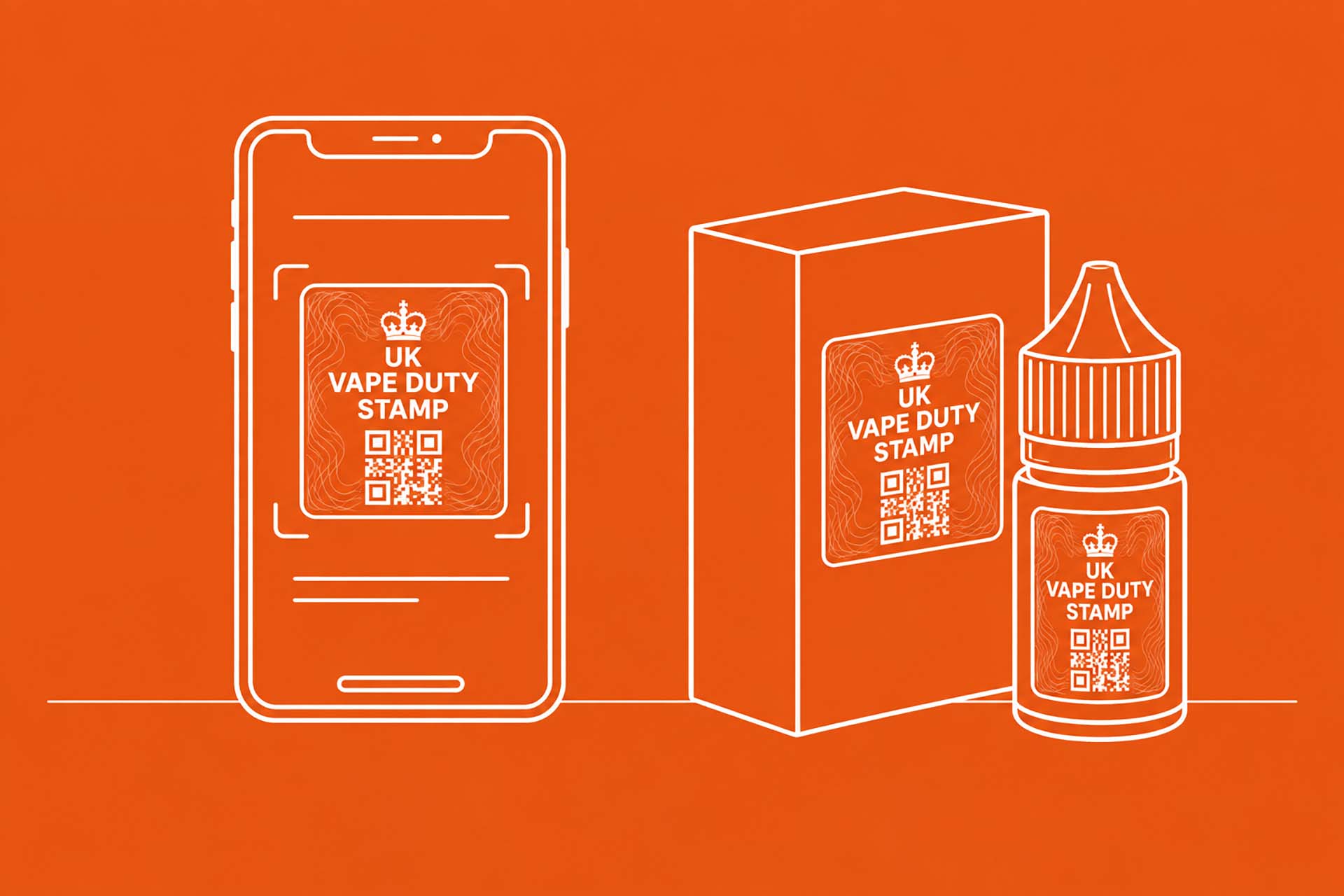
A vaping duty stamp isn't just an ink mark. It's a physical stamp with digital features built in. Those features carry data through the supply chain. That data covers who manufactured or imported the product. It covers product details too. And it tracks the product's journey to the shelf. HMRC only issues stamps to approved businesses. These are called Authorised Purchasers. They're approved manufacturers, importers and warehousekeepers, and they buy stamps directly from the scheme's appointed supplier.

So the stamp does three jobs at once. It proves duty has been accounted for. It gives HMRC a traceability trail. And it sits on your label, competing for space with your branding, your ingredients list, your batch code, and everything else you're already required to print.

The timeline you're designing against

Two dates matter here. They're easy to confuse. Vaping Products Duty starts on 1 October 2026, at a flat rate of £2.20 per 10ml. That's the tax. The stamps are the enforcement layer, and they run on a slightly different clock.

A transitional stamp carries businesses through the interim period. So you won't need finished, fully compliant stamp artwork on day one. Full duty stamps become mandatory from 1 April 2027. Retailers can keep selling unstamped stock only until 31 March 2027. After that date, an unstamped product isn't just non-compliant. It's illegal to sell, and it can be seized.

Read that timeline the way a production planner would. You have roughly eighteen months to move from "transitional" to "fully stamped." Artwork revisions take longer than most brand owners expect. Print trials do too. And packaging sign-off is rarely quick, especially once your printer is handling every other brand racing the same deadline.

Why this is a packaging problem, not just a compliance one

Here's the part that catches brand owners out. A duty stamp needs its own reserved space on the label. It can't overlap your logo. It can't sit on top of your nicotine warning or your batch code. And it can't be bolted on after your artwork is already at the printer.

Treat it as a design brief instead, and you sidestep the expensive alternative. That alternative is reprinting an entire run, because the stamp doesn't fit, obscures required text, or lands somewhere your production line can't apply consistently. A short list of questions helps you get ahead of it.

Ask your manufacturer these questions

  • Has our label layout got dedicated, unshared space for the stamp?
  • Does the stamp placement interfere with any of our existing mandatory text?
  • What happens to our artwork when transitional stamps switch to the next stage?
  • Who handles sourcing stamps as an Authorised Purchaser, and how does that fit our supply chain?
  • Will stamp integrity survive our actual production line, not just a design mock-up?

If your manufacturer can't answer these clearly today, your artwork risks becoming a rush job next year. And that's exactly when every other brand in the market starts chasing the same print slots.

Build it into your next artwork pass

The brands handling this well aren't racing the deadline. Instead, they're folding stamp space into whatever artwork revision they're already planning. That way, the compliance requirement rides alongside routine design work. It never becomes an emergency reprint.

That's a genuinely small ask right now. Left until 2027, though, it turns into a scramble. You'd be competing against every other brand's print run, your own retail deadlines, and a shrinking supply of press time.

Talk to us before your next print run

We work through label layout as part of production planning. That way, stamp space, mandatory text and your brand all sit together on the same artwork, first time. Want a second pair of eyes on your current packaging before your next print run?

Contact us to see how we can help keep you compliant ahead of the vape stamp duty.

British-Made vs Imported: What VPD Means for Cross-Border Brands

If your e-liquid comes from overseas, the 1st of October 2026 changes the maths. Vaping Products Duty applies to your stock the moment it enters the country, unless that stock goes straight into duty suspension. So the real question for any cross-border brand isn't just “how much will VPD cost me?” It's this: does importing still make sense once VPD, customs, and duty stamps all stack up together?

This article walks through what actually changes for imported liquid, and also where UK-made production sidesteps some of that complexity entirely.

What changes for imported e-liquid on 1 October

Right now, many brands treat import as a simple supply chain step. Order stock, clear customs, sell it on. From 1 October, that changes in three concrete ways.

First, you account for VPD at the point of import, unless the goods move directly into an approved excise or customs warehouse under duty suspension. If they don't, the duty falls due there and then. It doesn't wait until you sell the stock.

Second, duty stamps have to be on the product before it's released for UK consumption. If your overseas manufacturer applies the stamps before shipping, someone in the UK still has to manage that process. That someone is a UK representative, approved by HMRC specifically to purchase and handle stamps on behalf of an overseas manufacturer.

Third, your customs declaration now carries excise weight, not just trade weight. You need the correct tariff code and an accurate net liquid volume. You also need the paperwork behind it — invoices, packing lists, bills of lading. Get any of that wrong, and you risk delays or a seizure, not just a queried invoice.

The UK representative problem, in plain English

Here's the part that catches most import-led brands off guard. If your manufacturer sits overseas, they can't simply apply for UK duty stamps themselves. HMRC requires a UK-based entity to act as their representative instead. That entity needs its own approval, and it manages the stamps on the manufacturer's behalf.

That leaves a cross-border brand with a real choice before October. Find, and vet, a UK representative your overseas manufacturer trusts. Or find a UK partner who removes the question entirely by manufacturing here in the first place.

Either way, someone in your supply chain has to own this. It can't sit with nobody.

Stacking the real cost of importing after VPD

Before VPD, an overseas manufacturing route usually looked cheaper on paper. After 1 October, that comparison gets more complicated. The cost of imported liquid now includes several layers stacked on top of each other:

  • The landed cost of the product itself — manufacturing, freight, and any existing import duty or tariff
  • VPD at £0.20 per ml (that's £2.20 for a 10ml), due at import unless you've arranged duty suspension
  • The UK representative arrangement, if your stamps get applied overseas
  • Customs brokerage, plus the extra declaration detail excise treatment now demands
  • The operational risk of a shipment held up, or stock seized, over a stamp or paperwork error

None of this makes importing impossible. But the gap between a cheap overseas quote and landed, compliant, sellable UK stock gets wider. It's worth measuring properly, rather than assuming the old numbers still hold.

Manufacturing in the UK removes several of those layers at once. There's no import accounting step and no separate UK representative to arrange. There's also no cross-border shipment sitting at risk of a stamp error before it even reaches your warehouse.

The risk you inherit, not just the cost

Cost is only half the picture. When you buy finished liquid from overseas, you're also trusting someone else's compliance. That's someone you can't easily audit, and who may not fully understand UK excise law.

If stamps are missing, wrong, or applied by an unapproved party, HMRC can seize the stock. That's not a fine you negotiate afterwards. It's stock that simply doesn't reach your customers. And because the duty stamp scheme is new for everyone, an overseas manufacturer's confidence isn't the same thing as their compliance.

Questions worth asking before you commit

If you're weighing up whether to keep importing, put these questions to any current or prospective overseas supplier:

  • Who is your approved UK representative for duty stamps, and have you verified their HMRC approval yourself?
  • Will the stamps be applied before the stock leaves origin, or once it reaches the UK?
  • What documentation will you receive to prove duty has been correctly accounted for?
  • What happens, contractually, if a shipment gets held or seized over a stamping or paperwork issue?

If those answers feel vague, treat that as the signal to act.

Why brands are moving production onshore

None of this is about avoiding VPD. The duty applies to UK-made and imported liquid alike, and the rate doesn't change based on where you manufacture. What changes is how much complexity sits between production and a compliant sale.

Manufacturing in the UK collapses that chain. There's one legal entity responsible for the product and one compliance relationship to manage. There's no cross-border handoff where responsibility can blur. For a brand that's spent the last few months untangling UK representative rules and import declarations, that simplicity is the real appeal.

Xyfil's HMRC approval for Vaping Products Duty has been granted, and this covers importing as well as manufacturing within the UK. For more on our Vaping Products Duty services, read more here.

Importer of Preference: How an Excise Warehouse Handles Your Imports

If you import finished e-liquid into the UK, Vaping Products Duty changes your position more than most. The duty makes the importer liable, and it lands the moment your stock enters the UK market. So the way you bring stock in — and where it sits once it arrives — suddenly shapes your cash flow and your compliance. Let's walk through the smarter route.

What importing actually triggers

Under VPD, you carry the duty liability as the importer. You're not a passenger in someone else's supply chain — you're the accountable party, and that means registering with HMRC before you can lawfully bring vaping liquid into the country.

If you import product on behalf of an overseas manufacturer, the rules ask even more of you. You may need to act as their UK representative. That role carries real weight: you apply for approval on their behalf, and you buy the duty stamps too. HMRC looks to you, not the factory abroad, as the accountable party on UK soil.

Here's the point that catches people out. Importing doesn't dodge the duty. It simply decides who accounts for it — and, quite often, that's you.

From 1 October 2026, only two routes stay open for imported stock. Either it arrives already carrying a valid duty stamp, or it enters through an approved duty-suspension arrangement. Every other route closes on that date. That's a hard compliance line, not a soft recommendation, so it's worth mapping now rather than scrambling in September.

Bring stock straight onto the open market without either safeguard, and the duty falls due immediately. That's the expensive way to do it. You fund the full duty bill the moment the container lands, long before a single unit reaches a customer, and there's no way to claw that timing back once it's happened.

The excise-warehouse alternative

There's a calmer route. Instead of landing stock straight into the market, you bring it into an approved excise warehouse, where it sits in duty suspension. The duty point then waits until the goods are released for UK consumption — not the day they arrive.

Two mechanics make this work. First, an approved warehouse can legally hold duty-suspended stock, so nothing forces an early release. Second, that stock moves under EMCS, the system HMRC uses to track duty-suspended goods as they travel. Together, they let your imported stock wait, compliantly, until you genuinely need it.

And the same rule applies at the edges as it does everywhere else in VPD: stock you export onward, or destroy under bond, doesn't attract UK duty at all. You only ever pay on what genuinely enters the UK market.

Timing, not a discount

Let's keep this honest, because it matters. Holding imported stock in duty suspension doesn't reduce the duty on anything you eventually sell in the UK. If every unit releases to UK customers, the total bill stays the same. What changes is the timing: you pay as you release, not as you land. That's a genuine cash-flow advantage, and a legitimate one. It is not a way around the duty, and no manufacturer should pitch it to you as one.

How we can sit in the middle

This is where an excise warehouse earns its keep. We operate an approved bonded warehouse, so your imported stock can arrive and sit with us, duty-suspended, moving under EMCS until you choose to release it. In effect, our facility becomes the buffer between the port and the point of sale.

Our HMRC VPD approval is now granted, and our operations team has signed off the process end-to-end. Our credentials page, where you'll see the full detail, is launching soon. Until it does, we're happy to talk you through exactly where things stand today and what we can already carry for you.

Become the importer of preference

The brands that get this right won't scramble in September. They'll have a route mapped, a warehouse arranged, and their duty timed to their sales. If you import finished e-liquid, that's the position worth aiming for.

Common questions from importers

Do I need my own HMRC approval if I import finished e-liquid?

Usually, yes. As the importer, you're the liable party under VPD, so you register with HMRC yourself. If you bring product in for an overseas manufacturer, you may also take on the UK representative role, which brings its own approval and stamp-buying duties.

Does using a bonded warehouse remove my compliance obligations?

No. A warehouse changes when duty falls due, not whether you're registered and accountable. A partner can hold your stock duty-suspended and manage the storage and movement side, but the underlying registration still sits with whichever party the rules point to.

What happens if my stock arrives without a valid duty stamp?

From 1 October 2026, unstamped stock has to enter through an approved duty-suspension route rather than straight onto the open market. Arriving any other way risks falling foul of the rules, so confirm your route before you ship, not after.

Can I still import stock if I plan to export part of the shipment onward?

Yes. Stock you export onward, or destroy under bond, doesn't attract UK VPD at all. Only the portion that genuinely enters the UK market gets taxed.

So let's map your import route before the deadline sets it for you. Let's discuss - get in contact today.

Give Us Your Headache: What You Stop Paying For With a Managed Service

Vaping Products Duty doesn't just add a line to your costs. It adds a whole job. Approval, returns, stamps, storage, records — someone has to run all of it, every month, without slipping. So the real question for a brand owner isn't only "what does the duty cost?" It's "who's going to carry the work?"

Here's what that work actually looks like — and what you stop carrying when a managed partner takes it on.

The admin VPD quietly hands you

Go it alone, and this list becomes your day job.

  • Approval. You apply to HMRC and wait — potentially upwards of 45 working days — before you can lawfully release stock.
  • Monthly returns. You calculate the duty, file on time, and pay on time, month after month. Miss a deadline and penalties follow.
  • Duty stamps. You buy them from the appointed supplier, affix them correctly, and handle the scanning and records that come with the digital ones.
  • Duty-suspended storage. You either pay the duty up front, or you arrange approved storage so the duty waits until release.
  • Audit trails. You keep detailed records of every batch, every movement, and every stamp — ready for HMRC to inspect.
  • Precision on fill. Because duty tracks volume, every millilitre of over-fill is duty you've simply thrown away.

None of it is optional. All of it takes time, systems, and people. And every hour spent on excise admin is an hour not spent growing your brand.

What a managed partner absorbs

Now flip it. When you manufacture with a partner built for this, most of that list stops being yours.

We hold your stock in our approved bonded warehouse, so it sits duty-suspended until it ships. We run the batch tracking and the audit trails HMRC expects. We handle the stamps and the precision filling that stops duty leaking through waste. In short, the excise machinery becomes our problem, not yours.

That's the idea behind "give us your headache." You keep the parts of the business only you can do — the brand, the range, the customers. We take the parts that are pure operational drag.

Over a decade of doing exactly this

We've manufactured for hundreds of UK brands since 2014. So the systems that VPD now demands — records, storage, quality control, precise filling — aren't new to us. They're what we already run, every day, at scale. VPD simply adds a new layer, and we've built for that layer too.

That experience matters most in the moments that go wrong. A missed return, a mislabelled batch, a stamp error — each is a small crisis for a brand handling it alone. For a partner who does this daily, it's just process.

We said we'd tell you when it landed

We always said we'd be straight about where our approval stood. So here it is, confirmed in writing. Xyfil now holds HMRC approval for Vaping Products Duty, alongside our approved bonded warehouse. We can produce lawfully, hold your stock duty-suspended, and release it duty-paid as it ships.

That matters more than it sounds. Approval isn't quick — anyone applying now waits at least 45 working days before they can release stock. Partner with us and you skip that queue. You're not starting from zero.

Ready to hand it over?

If the VPD admin already feels like a second job, that's the signal. Let us show you which parts of it you can simply put down.

Hand us the headache →

Who Needs HMRC Approval, and What Happens If You’re Not Approved

The single most common Vaping Products Duty question we hear from brand owners is a simple one: "Do I need HMRC approval, or does my manufacturer handle that?" It's a fair thing to ask. And the answer decides who carries the risk on 1 October. So let's clear it up properly.

First, the rule HMRC actually applies

Approval follows the activity, not the name on the bottle. HMRC approves the business that manufactures, imports, or holds the stock — not simply whoever sells it to consumers. So your obligation depends entirely on how your product reaches the market.

One date makes this urgent. From 1 October 2026, it's against the law to manufacture vaping liquid in premises HMRC hasn't approved. That even includes mixing non-duty-paid liquids to make a finished product. In other words, "producing" is defined broadly, and unapproved production simply isn't allowed.

Three routes, three very different obligations

Most brands fall into one of three groups. Find yours below.

If you manufacture your own liquid

Then the obligation is yours, full stop. You apply to HMRC for approval, you buy and affix duty stamps, you file returns, and you carry the compliance day to day. There's no way to hand that off while you run your own production.

If you import finished e-liquid

Then you're liable for the duty, and you must register. And if you act as the UK representative for an overseas manufacturer, that responsibility sits squarely with you. Importing doesn't sidestep approval — it simply changes which approval you need.

If you use a UK manufacturer

Here the load gets lighter. When a UK manufacturer produces and releases your stock as the approved producer, the production-approval obligation sits with them, not with you. You still own your brand's side — your labelling, your records, and your choice of a genuinely approved partner. But you don't have to hold producer approval yourself.

What happens if you're not approved

The answer is simple, and it's serious. Without approval, you can't lawfully release duty-paid stock. You can't buy duty stamps either. And you can't manufacture in unapproved premises. Put those together, and the result is stark: no lawful route to market on 1 October.

Timing makes it sharper still. Approval isn't instant — HMRC warns it can take upwards of 45 working days. So if you apply late, you could sit unable to trade while the clock runs down. That's the real deadline hiding behind the headline one.

The quiet risk for outsourced brands

Even if you outsource everything, one duty stays with you: choosing a partner who is genuinely approved. If your manufacturer isn't approved in time, their problem quickly becomes your empty shelves. So the question isn't only "do I need approval?" It's also "can I prove my manufacturer has it?"

That's a fair thing to ask any supplier directly. A partner who can't answer clearly is a partner who leaves you exposed.

Where we fit in

We're HMRC-approved for VPD, so we can carry the production burden for the brands we manufacture for. That's the whole point of a managed partner. You focus on building your brand, while your manufacturer handles the approval, the stamps, the returns, and the stock.

So if you're not sure which of the three routes you're on — or whether your current setup leaves a gap — let's talk it through before the 45-working-day window makes the decision for you.

Speak to the team →

The £2.20 Trap: What Volume-Based Duty Does to a Stockpiled Warehouse

With October approaching, plenty of brand owners share the same instinct: build up stock now, before the duty lands. It feels sensible. Get ahead of the deadline, fill the warehouse, and ride out the change. Yet that instinct hides a trap — and the trap has a number on it. That number is £2.20.

Here's the problem in one line. Vaping Products Duty is volume-based, so a stockpiled warehouse turns that small-looking rate into a very large bill you pay long before your stock sells. Let's walk through why.

£2.20 looks small. At volume, it isn't.

From 1 October 2026, VPD adds £2.20 per 10ml to every UK e-liquid. That works out at 22p per millilitre. It applies whether your liquid carries 20mg of nicotine or none at all, because the duty tracks volume, not strength.

On a single bottle, the rate feels minor. Across a production run, though, it stacks up fast. A 2ml pod carries 44p in duty. A 10ml bottle carries £2.20. Multiply either by a warehouse full of stock, and the total climbs into six figures quickly. So the rate isn't really the threat. The volume is.

A full warehouse is a committed duty bill

Now picture the stockpiling plan in practice. You forecast a strong Q4. You produce a big run ahead of October. Then you hold it, finished and ready to ship.

Here's the catch. To keep finished, duty-paid stock sitting ready, you have already paid the duty. Say you build 500,000 2ml pods. At 44p each, that's £220,000 in duty — committed before a single pod reaches a customer. Your cash has left the business. Your stock, meanwhile, has not.

That's the trap. A stockpiled warehouse doesn't just hold product. It holds a tax bill you've already settled, on goods that haven't earned a penny yet.

Volume-based duty punishes the wrong stock

The trap bites hardest on slow movers. Think it through. You pay to store that stock. On top of that, you've fronted the duty on it. So a line that sells slowly costs you twice — once in storage, and once in duty you paid months too early.

Fast-selling lines recover quickly. Slow ones simply sit there, tying up cash you could spend on marketing, new formats, or your next launch. In short, the more you stockpile, the more working capital you freeze.

The duty point is your way out

Now for the good news. VPD doesn't attach to stock the moment it exists. Instead, it attaches at a trigger called the duty point. For most brands, that trigger fires when finished liquid leaves duty suspension for sale in the UK.

That single detail changes everything. If your stock waits in a duty-suspended state, the duty waits with it. You stop paying tax ahead of sales, and the bill starts to track your shipments instead. So the smart move isn't to stockpile duty-paid stock. It's to hold your stock so the duty falls due as you sell.

Two ways to hold stock without the trap

A managed manufacturing partner can hold your stock in a state that defers the duty point. In practice, there are two routes.

Route one: a bonded warehouse

Produce your full run, then hold the finished stock in a bonded warehouse. It sits duty-suspended until it ships. Order 20,000 units, release 10,000 to meet real orders, and duty falls due on those 10,000 — not on the full run. The remaining 10,000 simply wait in bond until you need them.

Better still, any stock you export or destroy under bond never attracts UK duty at all. So you only ever pay duty on what genuinely enters the UK market.

Route two: component form

Sometimes you don't need finished stock yet. In that case, a manufacturer can hold your ingredients — flavour concentrate, base and nicotine — stored separately. Unblended, they aren't vaping liquid, so they carry no duty. They are then blended and package to order, so the duty applies only on the volume you release.

Either way, your duty bill follows your sales rather than your production schedule.

This is timing, not a loophole

Let's be clear on one point, because it really matters. Neither route reduces the duty you owe on stock sold in the UK. If all your held stock eventually ships to UK customers, the total duty ends up exactly the same. You've simply paid it as you sold, not before.

That distinction is what keeps you safe. "Avoiding the duty" isn't a strategy — it's a fast route to a difficult HMRC conversation. Protecting your working capital by lining the duty point up with your sales, on the other hand, is completely legitimate. That's precisely what a bonded warehouse and component-form storage are built to do.

One more compliance detail is worth knowing. Once you package products for retail, HMRC allows just one move in duty suspension. Further movements trigger the duty early, so movement planning matters — another reason to lean on a partner who handles this every day.

Questions to ask before you fill a warehouse

Before you commit to a stockpiling plan, or to any manufacturer, put these questions on the table:

  • If I hold finished stock, is it duty-suspended in an approved bonded warehouse — or am I paying duty up front?
  • Can you hold my stock in component form and blend to order?
  • How do you plan stock movements so I don't trigger the duty early?
  • What batch tracking and audit trails will I get for HMRC?

Clear answers protect your cash. Vague ones leave you carrying the risk.

See your own number before October

Every brand's exposure looks different, because formats, volumes and release schedules all shift the maths. So before you build a single extra pallet, model your position first. Our VPD calculator shows what a stockpiled run would cost you up front — and what changes when the duty tracks your shipments instead.

Model your duty exposure with our VPD calculator →